
Recently, we visited Stockholm, Sweden, for a purpose other than art. Yet, the city has a way of incorporating art into daily life so that anyone, anywhere, can feel the presence of beauty. Art takes many shapes and forms beyond traditional painting (architecture, when it moves past the purely pragmatic, is art; so is folding parks into a city’s landscape), but this time I want to focus on the visual arts that aren’t built-in by design – the murals and art elements scattered through the streets.
In my experience, Stockholm is easiest to explore on foot, combined with the train, metro, or other modes of public transit. The SL app makes ticket purchasing simple across all transportation (you can also tap a card directly on the metro, or buy a physical ticket). The public transit, and the metro in particular, opens up a different world of art entirely – station murals, and, surprisingly, sculptures.
The metro station art
If you look through any “Stockholm metro art” listing (or if you happen to live in Stockholm), you’ll find 90 stations with their own distinct design – some understated, others much more elaborate. During our visit, we made it to three of them – Solna Centrum, Kungsträdgården, and T-Centralen – each with a different design, a different feel and look, and each one equally mesmerising.
Artsy metro stations aren’t unique to Stockholm. In fact, the tradition is most pronounced in Moscow, Russia, where the metro was intentionally built as “palaces for the people”, designed to bring the richness and beauty of the upper world into the everyday commute. This idea of art and intricate detail woven into the buildings of everyday life is old, and from experience most memorable in London: the factory-cast lamp posts along the river Thames, and the 1860s Crossness Pumping Station, now retired and transformed into a museum thanks to its “masterpiece of engineering – a Victorian cathedral of ironwork”. The people in power at the time believed that even the workers of a sewage pumping station deserved beautiful surroundings, despite or perhaps because of the difficult and dirty nature of the work itself.
Stockholm’s metro stations may not quite live up to the Russian idea of “palaces for the people”, but they offer something rarer – a collection of singular artworks carved directly into the bedrock, and it is known to be the world’s longest art exhibit, 110 km long in total.
Beyond the metro
The metro stations aren’t the only part of Stockholm offering art to everyday people. One of the areas for murals is Kista, which we happened to visit. While we did not find the Horned beetle Anaplophora, we found other equally beautiful street art to look at.
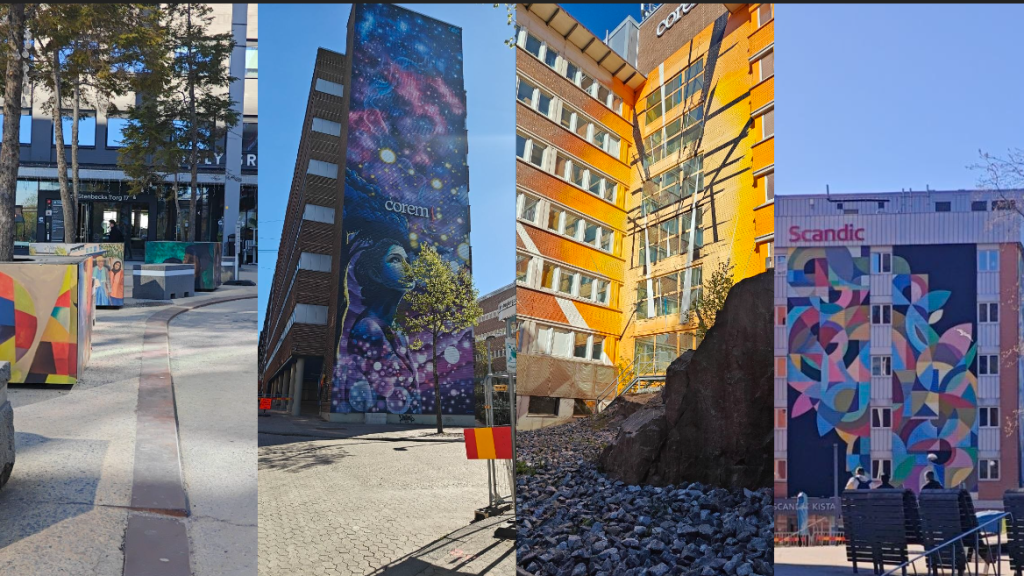
I have to admit, having art freely accessible to all people, whether visual, sculptural, or architectural, brings the desire for beauty to the surface of our being. Art, even when barely noticed by the everyday commuter, shapes how we see the world and our own lives, and lets us enjoy them a little more, even in times of hardship. I’m glad we visited Stockholm, and I’m already looking forward to returning to explore the rest of the freely accessible street art, and hopefully one of the more unique collections of Scandinavian artworks – the SEB headquarters’ art collection.
Written by Ieva Virse
Images and video in the article are all originally filmed or photographed in the locations in May 2026 by the article’s author. More and higher-quality images can be found in the pages linked from the metro station names.


 EN
EN  LV
LV